
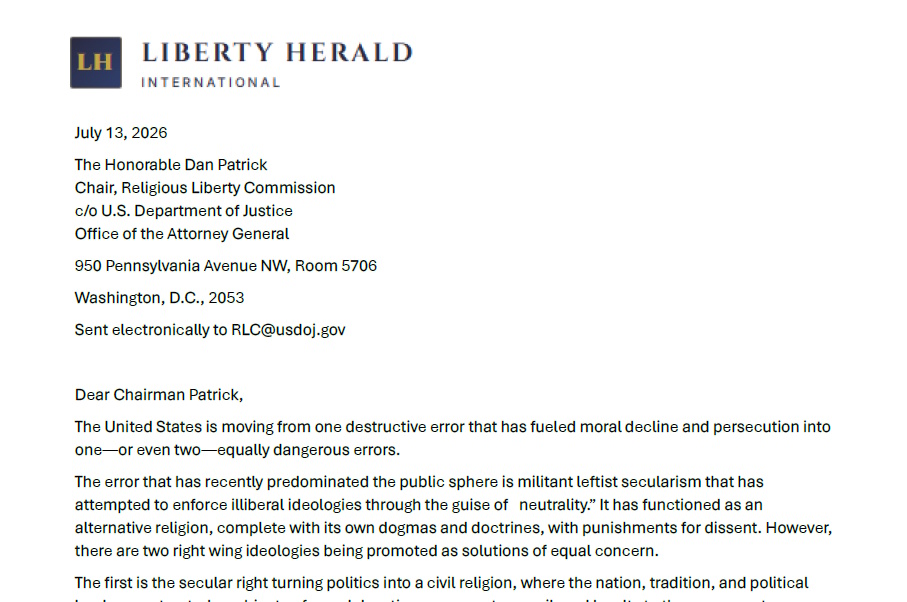
On July 13, LHI sent their response to the Religious Liberty Commission in response to the draft report. There were many more able lawyers, historians and theologians who were able to annunciate the details of religious liberty issues to the commission more clearly. However, LHI felt it essential to add the voice of this periodical to those who are proclaiming liberty of conscience. Please read LHI's response to the draft report.
Dear Chairman Patrick,
The United States is moving from one destructive error that has fueled moral decline and persecution into one—or even two—equally dangerous errors.
The error that has recently predominated the public sphere is militant leftist secularism that has attempted to enforce illiberal ideologies through the guise of “neutrality.” It has functioned as an alternative religion, complete with its own dogmas and doctrines, with punishments for dissent. However, there are two right wing ideologies being promoted as solutions of equal concern.
The first is the secular right turning politics into a civil religion, where the nation, tradition, and political leaders are treated as objects of moral devotion, opponents as evil, and loyalty to the movement as righteous.
The second of these erroneous ideologies is overtly Judeo-Christian, which pushes to encourage a more active role for Judeo-Christian religions within public institutions and civil life.
The moment the state begins favoring any religious persuasion or ideology, whether left wing liberalism, the secular right, or the Judeo-Christian right, through funding or facilitating its influence within civil authority, it ceases to act as a neutral guardian of liberty.
The abuses now blamed on militant secularism will continue under a different banner if the state begins favoring the secular right or Judeo-Christian religions through civil power. Whenever the government elevates one belief system above others, coercion and suppression inevitably follow.
Each ideology has an orthodoxy concerning the existential questions of life: how did I get here, why am I here, and where am I going, determined by who or what is regarded as the ultimate source of life and authority. Every person should be free to hold and practice those beliefs so long as they do not demonstrably infringe upon the liberty of others.
The Puritan-turned-Baptist minister and founder of religious liberty in the colonies of America, Roger Williams, observed that the first four of the Ten Commandments (Exodus 20:1-11) concern duties toward God and belong to the realm of individual conscience and religion (the church), not the state. Exodus 20:12–17 contain the final six commandments, which the state should uphold through law to protect the liberty of all. This division between the two types of moral laws provides a clear boundary of separation between church and state elucidated in Jesus’s admonition, “Render to Caesar the things that are Caesar's, and to God the things that are God's” (Mark 12:7). However, one need not look to scripture for wisdom as Roger Williams did. Secular political philosophers such as John Locke and Thomas Jefferson, as well as the practice of our first Presidents, also affirm the demarcation between what is and is not under the jurisdiction of the state.
 It has been the state's failure in its legitimate jurisdiction over man’s duty to man in civil governance, while simultaneously overreaching into matters of conscience and belief, that has led to the demise of society. Examples of the state’s failure to uphold the final six commandments include laws favoring abortion, permissive drug and theft laws, policies that favor both parents working, and weak restrictions on insider trading by government officials. Conversely, the state has violated the first four commandments by using civil power and public institutions to impose illiberal beliefs about origins, identity, and ultimate authority. The solution is not for the state to impose the beliefs of any religious tradition in the public sphere on these issues, but rather to remain silent and let such beliefs be taught in the home, the church, the synagogue, or the temple.
History repeatedly shows that when civil power joins itself to religion or ideology that functions as religion, it oppresses dissenters and corrupts the religion or ideology it favors. As Benjamin Franklin once wrote,
“When a Religion is good, I conceive that it will support itself; and, when it cannot support itself, and God does not take care to support, so that its Professors are oblig'd to call for the help of the Civil Power, it is a sign, I apprehend, of its being a bad one.”[1]
Likewise, Alexis de Tocqueville, once penned that all religious people of America,
“… attributed the peaceful dominion of religion in their country mainly to the separation of church and state.”[2]
James Madison warned,
“Rulers who wished to subvert the public liberty, may have found an established Clergy convenient auxiliaries. A just Government instituted to secure and perpetuate it needs them not. Such a Government will be best supported by protecting every Citizen in the enjoyment of his Religion with the same equal hand which protects his person and his property; by neither invading the equal rights of any Sect, nor suffering any Sect to invade those of another.”[3]
If religion is true to the first four commandments, it does not need the state to enforce it, and if government is just in relation to the last six commandments, it does not need the church to give it morality. Combine church and state, and both will corrupt the other until all that is left is rebellion and tyranny.
Respectfully,
Joanna de Bruyn
Editor, Liberty Herald International
[1] Benjamin Franklin, Benjamin Franklin to Richard Price, 9 Oct. 1780, The Founders' Constitution
Volume 4, Article 6, Clause 3, Document 5.
[2] Alexis de Tocqueville, Chapter XVII. - Democracy in America, Volume I (1835) - Chapter XV-IXX
[3] James Madison, Document 43, Memorial and Remonstrance against Religious Assessments
20 June 1785 Papers 8:298--304
Comment Policy
Just a short read, click here to read