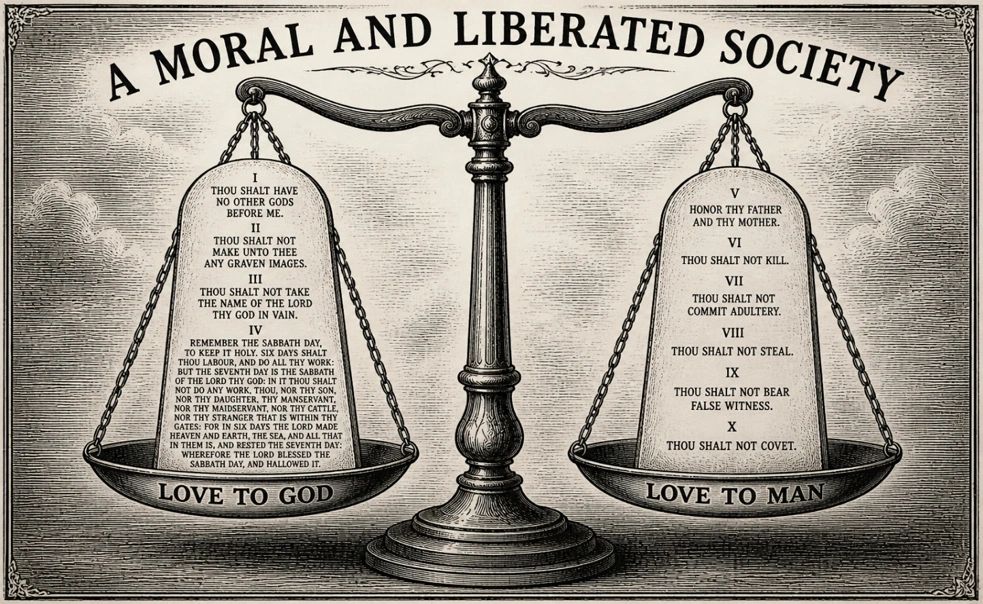
Notable voices have advocated for Christian Nationalism, suggesting that no nation can preserve liberty without a Christian people and Christian moral order obtained through the union of church and state. They suggest that the general decline of society is more likely when there is not a strong working relationship between the Christian Church and State powers.
There are three questions that we need to answer to examine the validity of these arguments:
1. What does it mean to be liberated or free?
2. Does Christianity provide the only basis of true religious liberty?
3. Is it possible to ever have a separation of church and state, and have a moral and liberated society?
What does it mean to be liberated or free?
To be liberated means freedom in three areas:
1. To be: freedom to develop your identity, conscience, belief, and personhood.
2. To do: freedom of action, speech, worship, and expression.
3. To go: freedom of movement, association, and participation in society
However, across the world, there is a consensus that your liberty or freedom must not simultaneously restrict another person's liberty.
There must be an equality and reciprocity in our liberties.
If equality between people is ever brought into question, it automatically removes liberty. A superior person or group will impose their values of what to be, to do, and the ability to go, on the inferior person or group. This has been
demonstrated throughout history, from situations of domestic violence, to human trafficking, to acts of genocide.
The only way to have lasting, genuine liberty for all is when every individual esteems the right-to-liberty of others as more important than their own. Consequently, no person seeks to assert their liberty over others, but rather facilitates the liberty of all. Such a Utopian existence is inconceivable in this world.
The fallen human state is characterized by selfishness and self-aggrandizement. Each person is more right in their own eyes than others. Moreover, wealth and power becomes an intoxicating elixir that convinces a person that they are the arbiters of liberty. While all this has been an age-old problem, modernity’s lack of societal connectedness and materialism have led to a decline in love for others and an increase in selfishness. This, in turn, has placed personal and societal liberty in increasing peril.
Does Christianity provide the only bases of True Religious Liberty?
Is Christianity the answer to this dilemma? I would argue yes. However, I argue it with much trepidation in a world where Christian Nationalism has grown in favor.
Of the three freedoms outlined earlier, it is the first freedom (to be) that defines how a person will express their liberty in the other two areas. Our beliefs, identity and conscience will determine what we say, how we act, how we worship, and how and where we associate and participate in society.
The basis of all religions, except true Bible-based Christianity, is a need to secure salvation through the effort of the person. Such religions also call on their adherents to contribute to the establishment of a moral world order in order to save the planet and save humanity as a whole.
Whether a person attempts to save themselves or the planet and humanity, it soon becomes apparent that these tasks are impossible.
If we are honest, when we focus on liberating ourselves from personal evil, the focus on the evil weakens our resistance to it. And when one evil finds a home in our heart, the evil of selfishness naturally finds its place there; this, consequently, leads to the individual denying the liberty of others.
Even if an individual could eradicate evil in their own life, the task of saving the planet and humanity is impossible. With every subsequent generation, there has been a greater capacity to annihilate the entire world with ‘one push of the button.’ To eliminate all such capacity would be to eliminate all selfishness that exists in the human heart. This is not something any human being can achieve.
The Bible teaches that Jesus Christ performs the work of salvation, and all we have to do is have faith in His ability to do so (Ephesians 2:8-10). This salvation isn’t limited to the cleansing from all individual sin or evil (1 John 1:7) in order to live selflessly with the liberating love of Jesus (John 15:13; 1 John 2:6; 1 John 3:16). Salvation that Jesus brings ends this world of suffering (2 Peter 3:10), providing a new heaven and a new earth without the blight of selfishness and evil (Revelation 21:1,4).
Jesus made it clear that His kind of truly liberating governance cannot be part of this world (John 18:36a). There are too many religious beliefs, and to impose one set of beliefs on all would be to restrict the very basis of all other liberties. Jesus said that imposing a Christian kingdom on this world would lead to fighting (John 18:36b)
Is it possible to ever have a separation of church and state, and have a moral and liberated society?
The word church in the New Testament is the Greek word ekklesia, which means ‘called out of.’ The church should be called out of the way this world operates and into the selfless, pure way that Jesus Christ lived. However, experience and scripture tell us that the visible church on this earth is made up of the godly and the ungodly (Matthew 13:24-30; Jude 1:4). Such an imperfect church is not capable of governing this world.
If the church unites with the state, those within the church who have selfish agendas will use their civil power to pursue goals that deny others their liberty.
One argument of Christian Nationalism that cannot be disputed is that morality has been declining. This decline is directly linked to a loss of Christian values. However, civil enforcement of morality leads to external compliance without the internal spiritual transformation needed to provide true liberty at either the individual or societal level.
In God’s heavenly kingdom, the church is entirely unified with the state and is characterized by the highest form of morality. There will come a time when this will be the reality on this earth. The Lord’s prayer that includes the words ‘Thy Kingdom Come’ (Matthew 6:10) is directed to the Father who is in Heaven. It is His work to do, not ours. And He will do it after every person on this earth has either decided to be entirely for or against Him (Revelation 22:11).
The Christian’s duty is not to engage in politics in order to achieve legislated morality. Rather, their duty is to call every person to choose which kingdom they wish to be a part of: the kingdom of heaven, where the King died to preserve the liberty of all people, or the kingdoms of this world, where liberty is defined by the people who have the most power.
Know More About This Story?
If you have additional information, corrections, or updates relating to this article – drop us a message directly.

Comment Policy
Just a short read, click here to read