
The Sunday Law Crisis of 1888
In the late 1800s, a movement arose to establish Sunday as a national day of rest in the United States. Many believed that unity and public morality could be encouraged through enforcing Sunday church attendance. Protestant groups, reform societies, and temperance organizations formed a coalition to advance this aim. Leading the effort was the committed prohibitionist and devout Christian, Republican Senator, Henry W. Blair, who introduced the National Sunday Rest Bill in May 1888.
The bill aimed “to secure to the people the enjoyment of the first day of the week, commonly known as the Lord’s Day, as a day of rest, and to promote its observance as a day of religious worship” (American State Papers Bearing on Sunday Legislation, pp. 360–363). Called Resolution 86, a “Christian Education” Amendment, it sought to amend the Constitution, effectively making Sunday a compulsory national rest day under the banner of morality and education.
If passed, it would have halted commerce, closed amusements, and limited work to necessity or charity. Interstate trade and even public events were to cease, giving the federal government sweeping power to enforce a nationwide religious observance under the pretense of preserving America’s Christian identity
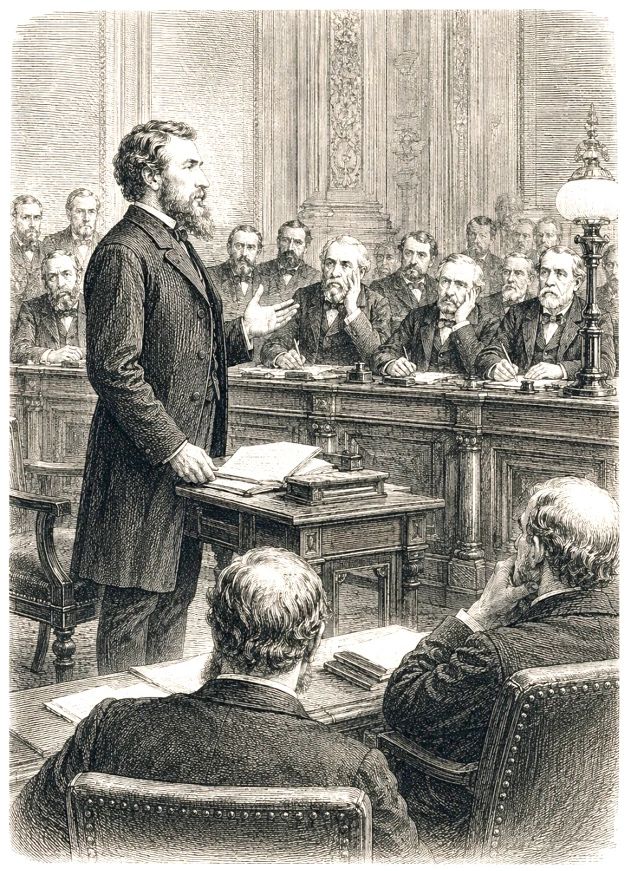
After its introduction, the bill was sent to the Senate Committee on Education and Labor, chaired by Senator Henry W. Blair. Hearings included both supporters and opponents. Among the strongest critics was Alonzo T. Jones, who spoke firmly in defense of religious freedom. He said,
“There is a limit to the lawmaking power. The government has no right to make any law relating to the things that pertain to God, or offenses against God, or religion. It [the government] has nothing to do with religion” (see The National Sunday Law, Argument of Alonzo T. Jones, December 13, 1888, p. 32).
Jones grounded his argument in Scripture and the Constitution, insisting Sunday laws are inherently religious and violate the separation of church and state. Citing “Render therefore unto Caesar the things which are Caesar’s; and unto God the things that are God’s” (Matthew 22:21), he argued that legislating Sabbath observance infringes on a sacred duty owed to God alone.
He further pointed to Article VI of the constitution: “no religious test shall ever be required,” arguing that neither majority rule nor civil power has the right to control conscience. So long as a person does not contravene the last six of the ten commandments, Jones declared that the nation should protect the citizen’s right to religion and leave him entirely free “to worship whom he pleases, when he pleases, as he pleases, or not to worship at all, if he pleases” (The National Sunday Law, Argument of Alonzo T. Jones, December 13, 1888, p. 43).
These words left a deep impression, and both the Sunday Law Bill and the Christian Education Amendment failed to advance, dying in committee.
The Sunday Law Crisis of 1892 & 1893
In 1892, Sunday law advocates regained momentum under Alfred H. Colquitt, who introduced Senate Bill 2168. Its stated purpose was: “to prohibit the opening on Sunday of any
exhibition or exposition for which the United States Government provides funding.” Though it failed in the Senate, the effort shifted to the House of Representatives (as Bill 7520). Commonly referred to as the Sunday Civil Bill, the bill was passed into law in August 1892. It ensured that a $5 million loan for the World's Columbian Exposition was approved on the condition it remain closed on Sunday, achieving indirectly what earlier laws could not.
 Chicago accepted the funding and the restriction, prioritising financial support for the grand exposition. The fair, showcasing global progress in industry, art, and culture, opened on May 1, 1893, and quickly drew vast crowds, becoming one of the most significant events in American history. Seeing the economic benefits from the fair's success, the organisers reversed the Sunday closure and opened all exhibits seven days a week. Attendance surged, profits increased, and what had seemed a triumph for Sunday observance was quietly undone by the pull of commerce.
Rome’s Challenge
The Fair's decision to open on Sundays sparked fierce backlash from Sunday-law advocates, leading to protests, public campaigns, and a nationwide debate that drew in the Roman Catholic Church. Cardinal James Gibbons circulated articles titled “Rome’s Challenge” in the Catholic Mirror during September 1893. These articles challenged Protestants to justify their observance of Sunday, arguing that the practice was rooted in the authority of the Roman Catholic Church rather than in Scripture. The clash surrounding the World's Columbian Exposition brought the issue into sharp focus, exposing deep divisions and raising enduring questions about the relationship between religion, law, and liberty.
Sunday Measures Defeated Again
In 1892 and 1893, Alonzo T. Jones addressed Congress and the House Committee on the Columbian Exposition, opposing Sunday laws on both biblical and constitutional grounds, and presented a petition of over 350,000 citizens in defence of liberty. As a result, the government did not strictly enforce Sunday closing, allowing the World's Columbian Exposition to remain open, and though attendance was reduced, it marked another notable victory for religious freedom.
Lessons for our day
What can be learned from these events of the past? In the midst of confusion, two voices stood out:
(1) The voice of Rome. They proclaimed that those who honored Sunday were those were giving allegiance to papal authority rather than to the God of Scripture; and
(2) The voice of A. T. Jones. He stood firmly on the side of Biblical truth, liberty, and righteousness.
If God’s people are to stand for true religious liberty, they cannot unite with religions or institutions that do not uphold the Biblical truth and God’s conception of liberty. These are the foundation of the last messages that God gives to the world in Revelation 14:6-13.
Comment Policy
Just a short read, click here to read